
Introduction: The importance of industrial coupling in modern industry
What is Industrial Coupling?
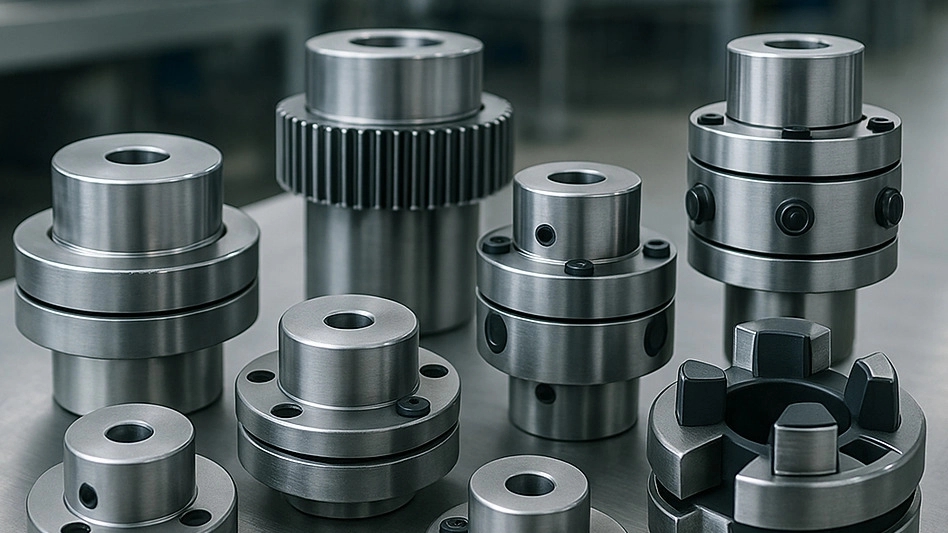
Industrial coupling is a mechanical piece used to transfer power and torque between two shafts. The industrial coupling connects between the rotating components of a device while also being able to compensate for a small amount of alignment, vibration, impact and mechanical shocks. The right selection of industrial coupling improves the performance of the device and enhances the safety of the set.
Types of industrial coupling and differences
Depending on the type of use, torque transfer capacity, the work environment and the expected level of industrial coupling, various types of this piece have been designed and manufactured. The following are the most widely used industrial coupling:
1. Flexible coupling
Flexible industrial coupling is used to compensate for the lack of balance and the absorption of vibration between the two shafts. This type of industrial coupling is usually made of materials that have elasticity or flexibility and tolerate sudden loads and non -alignment.
Flexible industrial coupling application:
is widely used in light and medium machinery, pumps, power transmission systems and industrial gearboxes.
2. Hard coupling
Hard industrial coupling has no flexibility and is suitable for thoroughly accurate shafts. If even the lowest level of non -alignment, this type of industrial coupling can cause serious damage to the device.
3. Gear coupling
Gear coupling is another type of industrial coupling that allows it to transfer high torque with its own design. The inner and outer ribs compensate for the axial and angular movement of the shaft.
4. Hydraulic coupling
hydraulic coupling is based on power transmission through fluids. In this type of industrial coupling, mechanical energy is first converted to hydraulic energy and then transferred to the output shaft.
5. Rubber coupling
Industrial rubber coupling is the best choice for high vibration absorption properties when vibration and impact. The middle part of this type of coupling is made of resistant plastic or tires.
6. Universal coupling
Universal or articular coupling can be angled. This advantage has made the Universal coupling in machines that are not in the same way.
7. Magnetic coupling
magnetic coupling is an advanced example of industrial coupling that works based on magnetic force and transmits force without direct physical connection.
The Role of Industrial Coupling in Increasing Production Systems Productivity
With the correct selection of industrial coupling, the productivity of the industrial complex can greatly increase. A suitable industrial coupling optimally transmits the generated force and protects other machinery components in the event of shock or error. Also, reducing any noise, vibration and problems caused by incorrect synergy are among the results of standard industrial coupling.
Conclusion:
Industrial coupling is the backbone of any industrial machinery. Without industrial coupling, non -standard power transmission, malicious vibrations, faster parts of the components, and the stopping of production line occur. Correct understanding of the types of industrial coupling and choosing it according to the capacity and need of machinery is to ensure productivity, reduce the cost of repair and increase the life of the machine.